What Was Filmed at Ait Ben Haddou? From Lawrence of Arabia to Gladiator
Films shot at Ait Ben Haddou, from Lawrence of Arabia to Gladiator and parts of Game of Thrones, and where to watch the ksar in evening light.
Ait Ben Haddou has been a film location since at least 1962: Wikipedia’s list runs from Lawrence of Arabia (1962) through The Mummy (1999) and Gladiator (2000) to Prince of Persia (2010), and the ksar was “also used in parts of the TV series Game of Thrones”. To see the walls the way a camera does, in low evening light, sleep facing them: Dar Mouna, a house opposite the village by its own page, says the place has drawn many directors, who used its settings.
The Films Shot at Ait Ben Haddou
Wikipedia’s article on Aït Benhaddou names these productions among the films shot there. It is a selection, not a complete list:
| Year | Film |
|---|---|
| 1962 | Lawrence of Arabia |
| 1975 | The Man Who Would Be King |
| 1977 | Jesus of Nazareth |
| 1985 | The Jewel of the Nile |
| 1987 | The Living Daylights |
| 1999 | The Mummy |
| 2000 | Gladiator |
| 2005 | Kingdom of Heaven |
| 2006 | Babel |
| 2010 | Prince of Persia |
The ten titles span almost fifty years, from 1962 to 2010. If you want to recognise it, watch one of these before you come: the walls and towers on screen are the ones you will walk past.
Was Game of Thrones Filmed at Ait Ben Haddou?
Yes, in part. Wikipedia says the ksar was “also used in parts of the TV series Game of Thrones”, and that is as far as the source goes: it does not name the episodes or the cities the ksar stood in for, so this guide does not either. If you are coming for the series, come for the ksar itself, which is what the production borrowed.
Why the Ksar Suits a Camera
UNESCO’s description reads almost like a location scout’s note. The ksar is “a group of earthen buildings surrounded by high walls”, a “traditional pre-Saharan habitat” in which “the houses crowd together within the defensive walls, which are reinforced by corner towers”. It calls Ait-Ben-Haddou “a striking example of the architecture of southern Morocco”, and inscribed it as a World Heritage site in 1987.
Three things follow for anyone behind a lens:
- One material. The buildings are earthen and climb a hillside next to the Asif Ounila, so the whole ksar reads as one piece from the river to the top of the hill.
- An outline. The walls and corner towers rise to the remains of a large fortified granary at the top of the hill, in Wikipedia’s description, which gives the hill its silhouette.
- History that is real. UNESCO places the ksar on “the commercial route linking ancient Sudan to Marrakesh by the Dra Valley and the Tizi-n’Telouet Pass”. The caravan town on screen was once a caravan town in fact.
Seeing It in the Evening Light
A day trip from Marrakech, 190 km away by Kasbah Tebi’s page, spends much of its time on the road. The low, warm light on the earthen walls comes at the ends of the day, so to see it you need to be here then, and a terrace facing the walls is the obvious seat:
- Dar Mouna has “a big panoramic terrace facing the site of the Aït Benhaddou (350 m² on 3 levels)”, by its lodging page.
- Riad Caravane describes “2 terraces with breathtaking views of the High Atlas and the Ksar”, for the sunset and, later, the stars.
- Kasbah Tebi, the one stay inside the ksar, has lounges over four levels with a view over the valley, and serves breakfast on the terrace at the top of the kasbah, in its own words.
- Riad Paradise of Silence lists an outdoor pool “with a view over the Ait Ben Haddou valley”.
See Riad Caravane for your dates
Dar Mouna, Opposite the Village, in Its Own Words
Dar Mouna’s French home page tells its own story. Its position, it says, is exactly opposite the village of Ait Benhaddou, and the house was built by the owner’s father around the 1940s, the oldest built in pisé facing the village. Its panorama, in its words, takes in the village, the relief and the meanders of the river, and the place has drawn many directors, who used its settings. Today it is a guest house with “12 big rooms entirely airconditioned”, a pool fed by spring water, “A big traditional HAMMAM” and an enclosed, guarded car park. Of those 12 rooms, 7 look out on the ksar, by its own room list, so ask for one of them when you book.
Where to Stay for the View
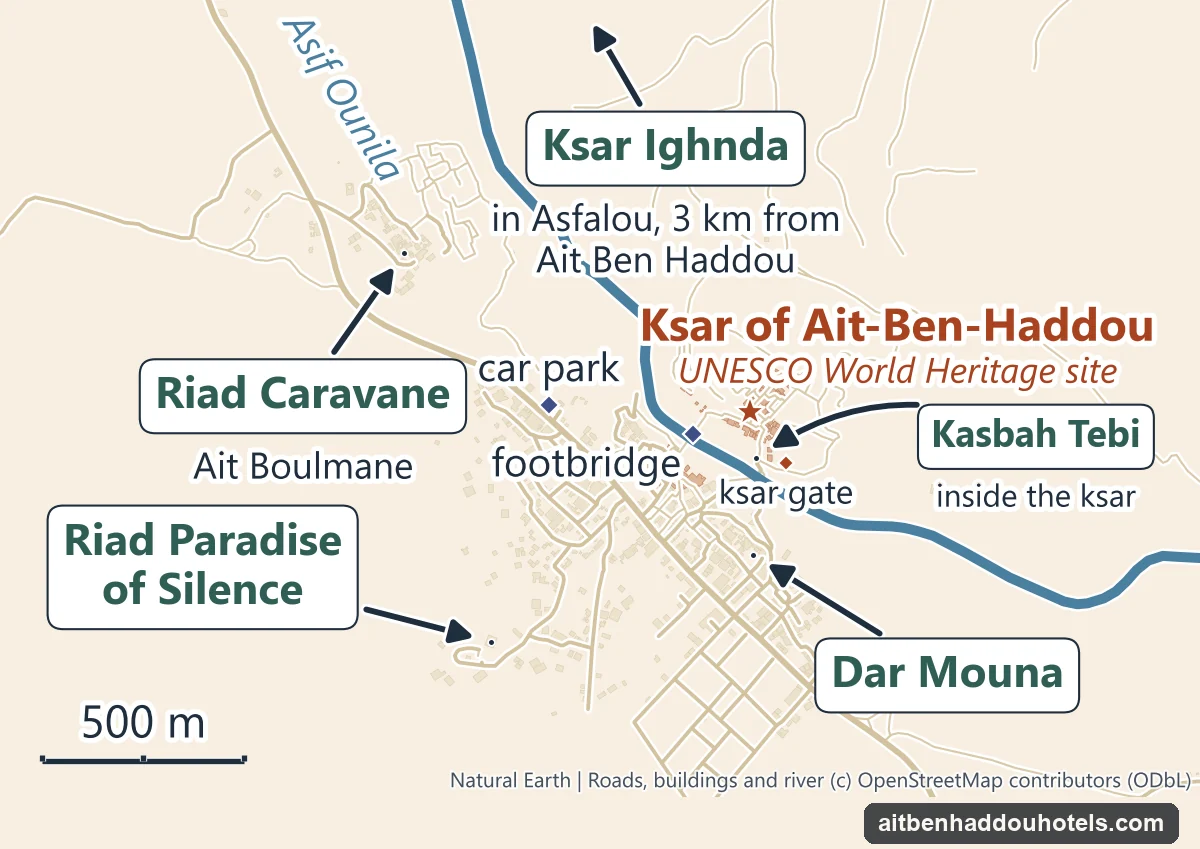
For the ksar from your own terrace, look at Dar Mouna or Riad Paradise of Silence, both facing the ksar in their own words. For a night inside the set itself, Kasbah Tebi is the stay within the walls. For terraces with the High Atlas behind the ksar, Riad Caravane, “3 minutes from the Ksar of Aït Ben Haddou” by its own page, about 1.6 km on foot to the footbridge.
Compare every bed in Ait Ben Haddou on the mapFor a walking plan of the ksar and the question of a night here at all, read is it worth staying in Ait Ben Haddou; for the drive and car park, how to get to Ait Ben Haddou.
Watch the Set After the Crews Have Gone
Each card opens a stay in or near Ait Ben Haddou with its rooms for your nights, terrace views included where the stay states them.
See the Ait Ben Haddou hotels